

In May of last year, 2024, I was lucky enough to visit the Passage Mounds of Meath in Northern Ireland whilst teaching with Tony Howard on the Jupiter Uranus conjunction in Dublin, Ireland. These Neolithic monuments, dated between 3200 to 5000 years old, were most likely ceremonial temples where Stone Age people celebrated their relationship with the cosmos around them, specifically through the interaction between light and the great goddess of the Earth. What’s so outstanding is that they had such intimate knowledge of the relationship between the Earth and its ‘lights,’ 600 years before the Pyramids at Giza were built and a thousand years before Stone Henge.
Each mound was built at a specific location and elevation so that the light of the Sun or Moon would travel to the heart of the mound only during specific cosmological alignments with the Earth. The passageway at Newgrange was built to receive the rays of the rising Sun at the winter solstice. The mound at Knowth received the light of the Moon, as it is aligned with the lunation cycle. Dowth acts as a counterpart to Newgrange in that the Sun enters the westerly facing passage on the same winter solstice but at sunset not sunrise, thus marking the entire complex with a system for celebrating the shortest, darkest day of the year as a turning point between death and re-birth, of the impregnation of the sacred and fertile Earth with the penetrating light of the Sun.

In her book, The Language of the Goddess, Marija Gimbutas points out “there can be little doubt that Newgrange represents the earth’s womb, from which life comes and to which life returns – the birth-giving and regenerative aspects of the goddess. As sunlight and moonlight enter the cairns, they illuminate different carved symbols at different times. More detailed investigation of this might reveal an actual narrative being spelt out as the different symbols are illuminated.”
In addition to the internal symbols carved into the face of the passageways, all three monuments were discovered surrounded with many smaller cairns and elaborate stone carvings on “kerb stones” displaying abstract symbols associated with aspects of the great goddess and delineating the passage of the Sun and Moon in their different cycles.
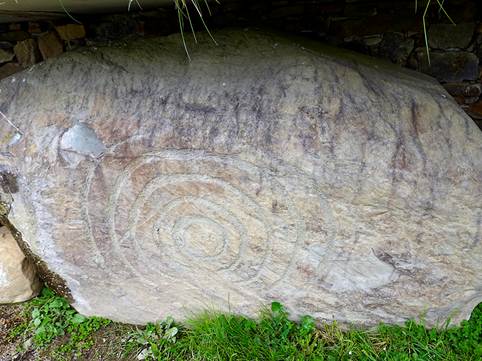
Gimbutas concludes that these symbols represent what she calls a “metaphysical alphabet,” thus positioning these megalithic works as representing something beyond the purely physical measurement of time, although they did this with astounding accuracy. In this metaphysical alphabet are we looking at the early, yet already sophisticated, origins of astrology: the logos (language, speech, or word) of the stars? The period in which they were built places the mounds at Meath in a similar era to the Sumerian culture in Mesopotamia, a thousand years before the rise of the Babylonians and the supposed origins of astrology. Isn’t it so amazing that ancient societies adopted similar cultural practices despite being continents apart? It is inherent in man to seek meaning, and what we find in this metaphysical alphabet of our ancient ancestors is a living language which has evolved through the passage of time.
